

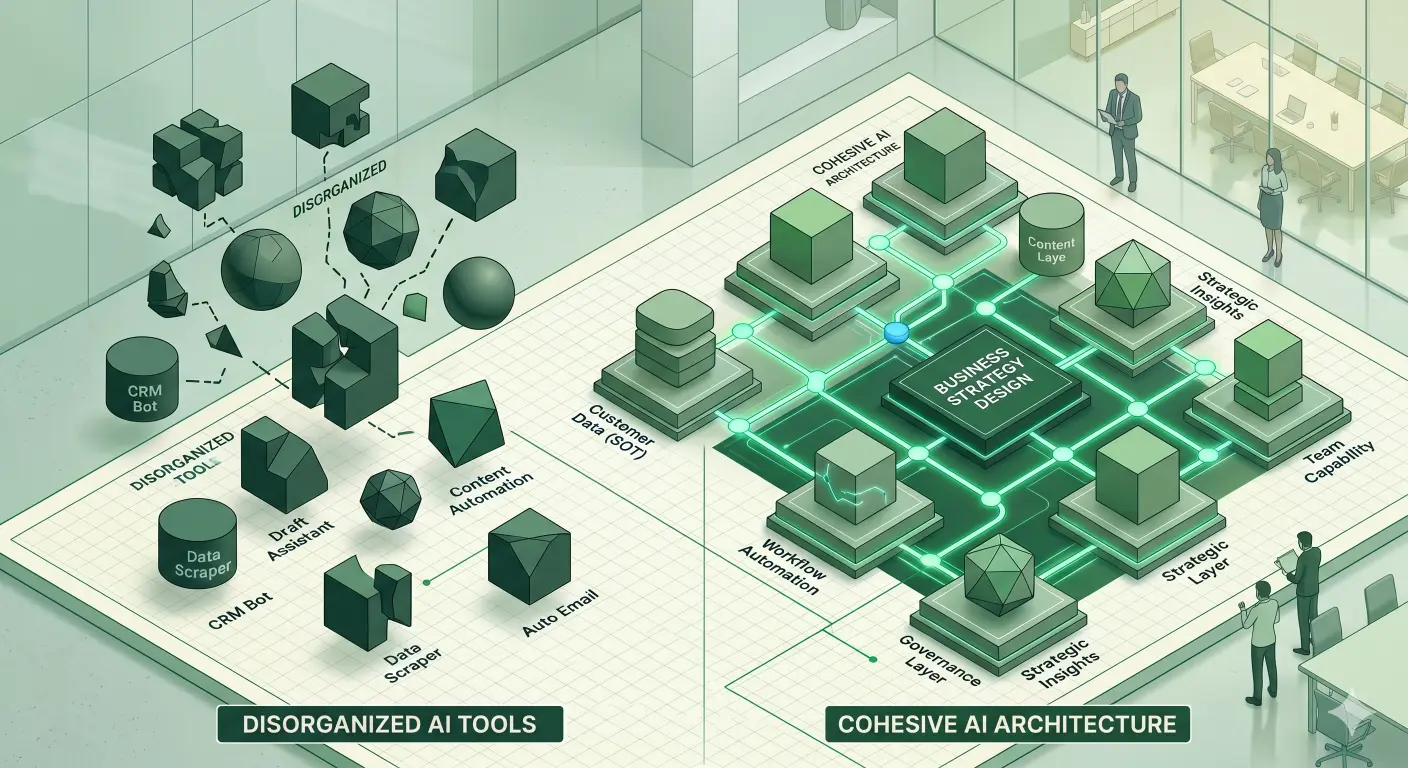
Most businesses I talk to are not short of AI tools. They have the subscriptions, the automations, the assistants. What they’re short of is a coherent picture of how any of it fits together.
That gap has a name. It’s called AI architecture. And in my experience, it’s one of the most consequential things medium-sized businesses are not yet treating as a deliberate decision.
What I Mean by AI Architecture
It’s easy to confuse AI architecture with IT infrastructure or software procurement. It’s related to both, but it’s different.
AI architecture is the strategic design of how artificial intelligence sits inside your business. Not which tools you use (that’s the easy part) but how they connect to each other, what data they can access, who is accountable when they get something wrong, and which capabilities belong to you versus which you are effectively renting from someone else.
When I started paying attention to this question properly, I realised most businesses are making architectural decisions constantly without naming them as such. Every time you connect a new AI tool to your customer data, you’re making an architectural decision. Every time you automate a workflow and don’t document who owns it, you’re making an architectural decision, by default rather than by design.
Default architectural decisions compound. That’s the problem.
Why Medium Businesses Are Most at Risk
Large organisations have people whose entire job is to think about this. Small businesses are often nimble enough to change course when something doesn’t work. Medium businesses (the 50 to 500 person range) sit in uncomfortable territory. Complex enough that architectural mistakes create real operational damage. Lean enough that they rarely have the capacity to think ahead of the decisions they’re already making.
The patterns I keep seeing are consistent:
Fragmented data. Different AI tools holding different slices of business knowledge, each developing its own version of the truth.
Ungoverned automation. Workflows running in the background that nobody fully understands and nobody owns. These feel efficient until something goes wrong and you can’t trace why.
Quiet lock-in. Tools chosen for convenience that turn out to hold critical data or sit at the centre of key processes, and leaving them becomes genuinely difficult.
None of these feel dramatic at the time. That’s what makes them worth paying attention to.
The Long-Term Questions That Rarely Get Asked
The short-term costs of poor AI architecture are visible enough: wasted spend, duplicated effort, frustrated staff. It’s the longer-horizon questions that are harder to sit with.
What happens when you want to change vendors? As AI services consolidate inside proprietary platforms, the tools you’re using today are also the platforms competing for your long-term dependency. A tool that solves an immediate problem can quietly become a strategic constraint. The right question to ask before adopting anything significant is not just “does this work?” but “what does it cost us to leave?”
Who is accountable for AI outputs? As AI takes on more decision-adjacent roles (drafting, flagging, prioritising) the question of accountability becomes genuinely tricky. Businesses that haven’t built governance into their AI architecture are accumulating a liability. Not a theoretical one. A practical one, as regulations mature and as the outputs of ungoverned systems start to create real problems.
What are you actually building? This is the one that interests me most. Organisations that outsource every AI decision to vendors or consultants get short-term results but build no capability. The businesses that will be genuinely better positioned in five years are the ones that develop real understanding of how their systems work, not just how to use them.
The Build-Versus-Buy Question Is the Wrong Question
I’ve noticed that when people start thinking about AI architecture, they often land on build-versus-buy as the central dilemma. Build your own AI systems in-house, or buy off-the-shelf solutions from vendors. It feels like a strategic framing. In practice, it usually obscures the more important question.
Buying makes obvious sense for capabilities that aren’t central to what makes your business distinct. If AI can handle your scheduling, your document processing, your standard communications, and a vendor has already solved that well, building from scratch is a poor use of resources. The argument for buying is clear.
But there are things you shouldn’t outsource the understanding of. Your customer relationships. Your operational knowledge. The shape of how your business actually works. These are where AI can create genuine advantage, and also where over-relying on vendor solutions can hollow out your organisation’s ability to steer.
The question that actually matters is this: what do you need to own, and what can you trust others to run? Getting clear on that is the real starting point for an AI architecture strategy.
External help is genuinely valuable here. A good advisor doesn’t replace your judgment; they help you develop it faster by sharing patterns and frameworks you’d otherwise take years to accumulate. The right advisory relationship makes you more capable, not more dependent.
Where to Actually Start
An AI architecture review doesn’t require a six-month project or a dedicated technology team. For most medium businesses, the essential starting point is quite practical.
Map what you already have. List every AI tool, subscription, and automated workflow currently touching your business. Understand what data each one holds or accesses. Most businesses haven’t done this, and the picture is usually more complex than they expect.
Identify where AI could create genuine advantage. Not where it could save some time, but where it could make you meaningfully better at the thing your business is built around. These are the areas worth building toward rather than just buying into.
Look for governance gaps. Which automated decisions in your business currently have no clear owner? Where would you struggle to explain to a client, a regulator, or a new employee exactly how an AI-assisted decision was made?
Invest in your team’s literacy. Leadership doesn’t need to understand the technical details of AI systems. They do need to understand enough to ask good questions of vendors and advisors, and to recognise when they’re being sold a solution rather than helped toward a strategy.
A Genuine Opportunity, If Taken Seriously
What I find interesting about this moment is that it’s still genuinely open. The businesses treating AI architecture as a deliberate strategic discipline now will have coherent, scalable foundations. Those that keep accumulating tools and hoping it works out will spend the next few years untangling decisions they barely remember making.
That gap will widen considerably over the next two years. The tools are moving faster than the thinking, and that imbalance creates risk, but also real opportunity for businesses that choose to think carefully.
This is exactly the kind of conversation we want to have more of inside Forge & Guild. Not the vendor pitch version of it. The honest version. What’s actually working? What are the real constraints? Where does the theory break down against operational reality?
If you’re a business owner, operator, or leader working through these questions, whether you’re just starting to think about AI architecture or you’re already deep in decisions you’re not sure about, I’d like to hear from you. The conversation is more useful when it’s real.
You can reach me through our Contact page, or connect on LinkedIn.
The decisions about AI that most need to be made aren’t technical. They’re about how you want your business to work, and who gets to decide.
Related reading
For the compliance groundwork that pairs with this, see AI Self-Governance for Small Business: A Plain-English Guide to the Rules Nobody’s Written Down Yet. For a walk-through of what’s actually changing day to day, see What AI Actually Changes.