

Most people don’t think about data centres as neighbours. They’re utilities, somewhere your emails live, your files sit, your cloud services run. But what if they were also something else? What if they were the heating system for your neighbourhood, or the engine powering the vertical farm that grows your vegetables?
I’ve spent the last few months researching exactly this question. It started as curiosity about Australia’s renewable energy challenge. We generate enormous amounts of solar and wind power, but we can’t always use it when we make it. That’s called curtailment, and it’s economically wasteful. But what if data centres, which are fundamentally just computers that produce heat, could be positioned as part of the solution? Not just as energy consumers, but as anchor infrastructure for circular economy systems.
What I found surprised me. Globally, there are already working models. In Ireland, Amazon’s data centre in Tallaght is heating community buildings, residential apartments, and a university campus through a district heating network. In Finland, Microsoft and Fortum are supplying heat to roughly 250,000 people across Espoo, Kauniainen, and Kirkkonummi. In Canada, QScale is building a 130-acre campus designed to simultaneously operate a data centre and produce 80,000 tonnes of fresh produce annually using waste heat. In South Korea, the government is actively easing regulations to allow vertical farms to operate within industrial complexes, capturing heat from manufacturing and digital infrastructure.
But here’s what’s missing: nobody’s yet systematically integrated all of this together in one place. Nobody’s mapped what happens when you combine high-density vertical farming, waste heat recovery, district heating, and community economics all at once. That’s the gap. That’s the opportunity.
Why this matters for Australia
Australia’s energy landscape is distinct. We have world-class renewable resources but real constraints around storage, grid capacity, and the mismatch between when we generate power and when we need it. We also have food security challenges. We import significant fresh produce, we’re vulnerable to supply chain disruptions, and our agricultural sector faces water scarcity and climate volatility.
Data centres are coming to Australia regardless. The explosive growth in artificial intelligence is driving unprecedented demand for computational infrastructure globally, and Australia is positioning itself as a strategic partner for data sovereignty, keeping critical digital infrastructure and data processing onshore rather than reliant on overseas providers. That demand means data centres will expand significantly. The question isn’t whether we’ll have them, but whether we’ll position them as isolated energy consumers or as anchors for resilient, circular systems.
What I found in my research to date is that the successful models aren’t the result of one clever technology. They’re the result of deliberate collaboration between data centre operators, energy utilities, agricultural innovators, and local government. They require policy frameworks that make these integrations possible. They require honest conversations about what works and what doesn’t.
What I’m learning from the world
I’m currently preparing to travel to Canada, Ireland, Finland, and South Korea to sit down with the organisations actually doing this work. Not to copy their models, that would be naive given our different climates and infrastructure, but to understand the principles. What are the real constraints they’ve hit? What surprised them? What economics actually stack up, and what doesn’t? What policy changes made integration possible?
My focus is particularly on vertical farming integrated with data centre heat. High-density food production uses enormous amounts of energy for climate control. Data centres produce enormous amounts of waste heat. On paper, it’s symbiosis. In practice, it’s more complicated. I want to understand that complexity.
What I’m looking for from organisations and communities
I’m not approaching this as an academic researcher looking to publish a paper, or as a consultant trying to extract competitive intelligence. I’m approaching it as someone who wants to bring working knowledge back to Australia, to help our communities, our policymakers, and our businesses think differently about how data centre infrastructure can create value beyond just digital services.
I’m actively reaching out to the teams doing this work globally. I want to understand their honest experience, the logistics, the challenges, the failures as much as the successes. I want to see facilities where this is actually happening. I want to ask hard questions about economics and scalability. And I’m doing this through a Churchill Fellowship application, which means I’ll be travelling to these sites with genuine time to learn, rather than rushing through meetings.
If you’re working on data centre integration, circular economy systems, or vertical farming at scale, whether you’re in government, operating infrastructure, or running farms, I’d like to hear from you. What have you learned? What would you do differently? What opportunities do you see that others are missing? I’m also keen to explore long-term collaboration at smaller scales. This isn’t just about the big projects. It’s about understanding principles that could apply anywhere.
A note on funding and commitment
I’m applying for Churchill Fellowship funding right now to make this research happen properly. The fellowship would give me four to eight weeks between late 2026 and early 2027 to actually spend time with these organisations, ask real questions, and understand what they’re doing. That’s quite different from a quick site visit where you’re just ticking boxes. But here’s the thing: if the funding doesn’t come through, I’m still doing this work. These questions matter too much, and what I’m learning is too valuable to just walk away. So whether the fellowship happens or not, I’m committed to understanding how we can bring this thinking back to Australia.
The bigger picture
What excites me about this research is that it sits at the intersection of energy, food security, community resilience, and circular economy thinking. It’s not siloed. It requires genuine collaboration between sectors that don’t normally talk to each other. That’s messy. It’s also where real innovation happens.
Australia has genuine strengths. We have renewable energy, we have agricultural expertise, we have tech capacity, we have communities that care about sustainability. What we’re missing is the connective thinking. We’re missing the conversations that ask: what if these things weren’t separate problems but actually solutions for each other?
That’s what I’m researching. That’s what I’m learning from the world. And that’s what I want to bring back.
If you’re interested in this space, whether you’re operating data centres, growing food, designing energy systems, or working in policy, I’d love to hear from you. You can reach me through Forge and Guild, or connect with me on LinkedIn.
The future of our food and energy systems doesn’t have to be either-or. It can be both
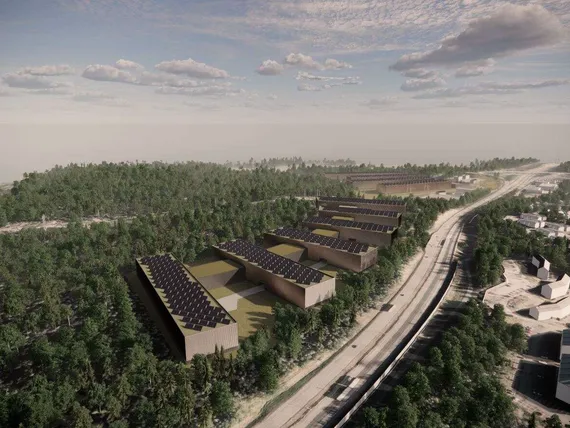
Image credit: Planning and consulting firm Ramboll has created visualizations of the buildings for Microsoft’s data center area in Hepokorvenkallio. Maria Korteila