

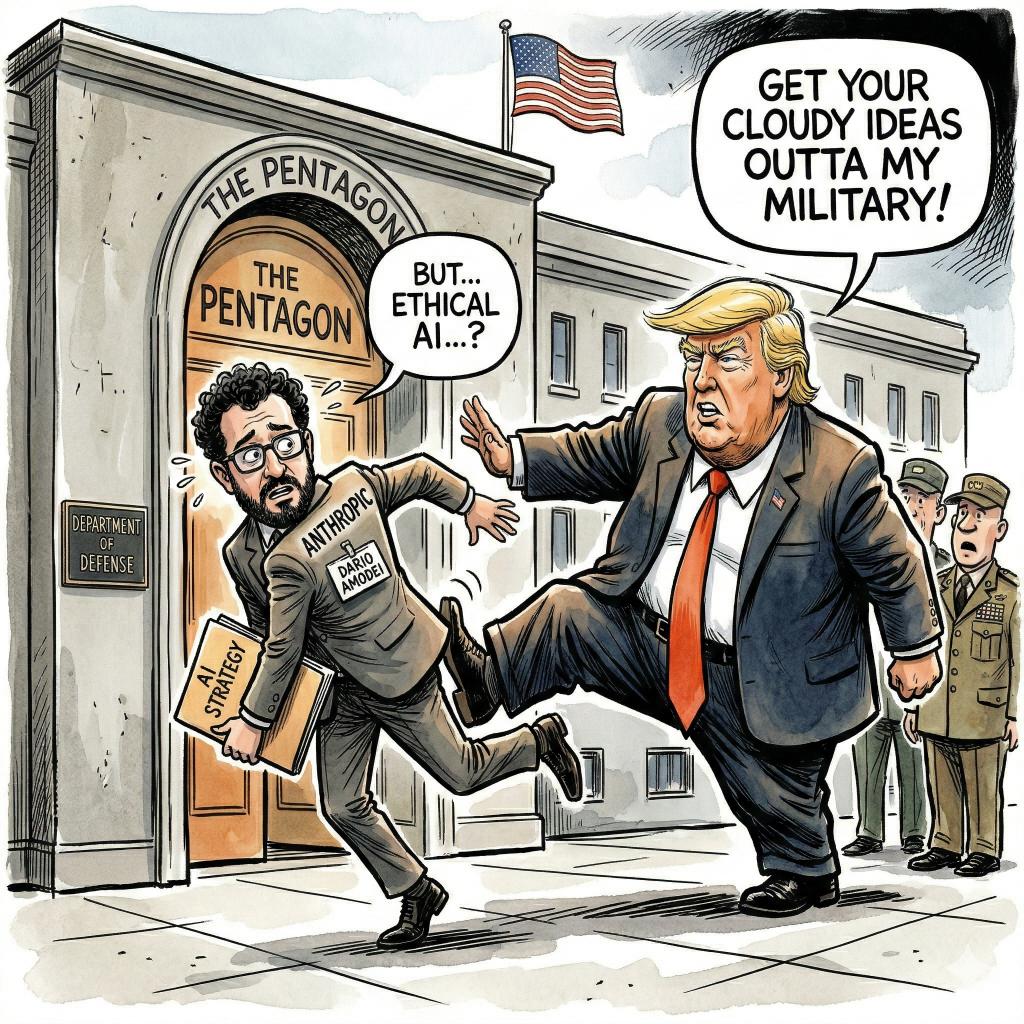
In the final week of February 2026, a confrontation that had been building for months came to a head. The United States government ordered all federal agencies to stop using technology from Anthropic – one of the world’s most advanced artificial intelligence companies – after it refused to remove safety guardrails from its AI model, Claude [1]. Within hours of the deadline passing, competitor OpenAI had announced a new deal with the Pentagon to fill the gap [2]. The situation played out like a geopolitical thriller, but buried within the drama is a set of questions with direct relevance to Australia’s defence future, our relationship with AI vendors, and how prepared we are for the era of AI-enabled warfare.
What Actually Happened
Anthropic had been the only commercial AI company operating inside the Pentagon’s classified networks, under a contract worth up to $200 million awarded in mid-2025 [3]. The contract positioned Claude as a foundational tool for US military intelligence and decision support – a significant milestone for the industry.
The dispute centred on two restrictions Anthropic had embedded in its acceptable-use policy: a prohibition on using Claude for mass domestic surveillance of US citizens, and a ban on deploying it in fully autonomous weapons systems – where AI, not humans, makes the final targeting decision [4]. The Pentagon’s position was that vendors must make their models available for “all lawful purposes,” leaving usage determinations to military commanders [5].
Anthropic’s CEO Dario Amodei held firm. “We cannot in good conscience accede to their request,” he wrote publicly, calling out the specific risks that AI-enabled surveillance and autonomous lethal weapons pose when current AI systems are not yet reliable enough for such high-stakes decisions [6].
The Trump administration’s response was swift and unprecedented. Defence Secretary Pete Hegseth designated Anthropic a “supply chain risk to national security” – a classification normally reserved for foreign adversaries – effectively forcing any company with US military contracts to prove they have no commercial relationship with Anthropic [7]. It is the first time in history this designation has been applied to a US-based company, in what experts described as apparent retaliation for a contractual dispute [2].
OpenAI moved quickly. CEO Sam Altman announced the same restrictions his company had agreed to: no mass surveillance, no fully autonomous weapons. The difference, apparently, was in how those limits were written into the contract – and who blinked first [2].
The Question Nobody in Australia Is Asking
This story broke across US media with intense coverage. In Australia, it received comparatively little attention. That silence is itself worth examining.
Australia’s defence strategy is deeply intertwined with the United States. Through AUKUS Pillar II, Australia is co-developing autonomous weapons systems – including underwater vehicles, loitering drones, and AI-guided strike platforms – alongside the US and UK at a pace defence officials describe as “go big, go fast” [8]. Australian-developed capabilities like the Ghost Shark autonomous underwater vehicle and the OWL-B loitering strike glider have already been trialled in joint exercises [9].
The tools enabling these systems – the AI models at their core – are almost certainly sourced from the same companies now being wrestled over in Washington. The question of what ethical guardrails apply, and who controls them, is not abstract for Australia. It is live and urgent.
Yet Australian public debate on AI in defence is notably sparse. Part of this is structural. Australia’s defence activities are shielded from the Privacy Act. The December 2024 Privacy Act reforms, which introduced new rights for Australian citizens, explicitly exclude defence and intelligence operations [10]. Australia supports only voluntary international measures on autonomous weapons rather than binding treaties – effectively reserving maximum flexibility for the future [11].
Foreign Minister Penny Wong told the UN Security Council in late 2025 that “decisions of life and death must never be delegated to machines” [9]. Meanwhile, the ADF is rapidly expanding its fleet of exactly such systems. That tension between stated values and actual capability development has not received the scrutiny it deserves.
Why This Matters for Australian Strategy and Business
The Anthropic-Pentagon standoff reveals something strategically important: the companies that build foundational AI are increasingly willing to set their own red lines, even under government pressure. The next AI vendor dispute – and there will be one – may involve a platform embedded in ADF systems.
This creates risks that defence planners, industry partners, and government advisors need to think through now:
Alliance cohesion. Australia’s AI capabilities under AUKUS are built on interoperability with US systems. A US-based AI company being blacklisted mid-contract creates exactly the kind of supply chain disruption that weakens allied coordination [12]. The vendor dispute in Washington is also Australia’s problem.
Who sets the ethical floor? Anthropic’s stand – whatever one thinks of the political drama – forced a public conversation about what AI should and should not do in warfare. Australia has not had that conversation domestically. If the ethical guardrails of AI systems used by the ADF are being set in Silicon Valley boardrooms and Pentagon negotiations, Australians deserve to know and to have a view.
The responsible-by-design advantage. International law experts monitoring the UN’s Convention on Certain Conventional Weapons have noted that AI companies which embed responsible-use principles are better positioned as global regulations tighten [12]. Defence contractors, alliance partners, and procurement teams increasingly scrutinise ethical AI frameworks. The companies – and countries – that build those frameworks now will have a strategic and reputational edge as the regulatory environment matures.
A More Useful Frame
It would be easy to read this story as either a tale of corporate overreach (a private company trying to dictate terms to a democratic government) or a cautionary story about military AI run amok. Neither framing is particularly useful for Australian defence thinking.
A more productive frame: the Anthropic-Pentagon confrontation is a preview of the governance challenges every defence nation will face. The technology is developing faster than the legal and ethical frameworks designed to manage it. Companies, governments, and alliance partners are all improvising [13].
Australia’s current position – developing autonomous capabilities rapidly, maintaining flexibility on international rules, with minimal public debate – reflects a choice. It may be the right strategic choice. But it is a choice being made in the absence of the informed public conversation that decisions of this magnitude warrant.
The United States just had that conversation, explosively and publicly, in the middle of a live contract dispute. Australia would do well to have it more deliberately – before the moment of crisis arrives.
Forge and Guild works with organisations navigating the intersection of strategic AI adoption and defence-sector opportunities. For more on how AI governance is reshaping defence procurement and capability development, follow our series.